
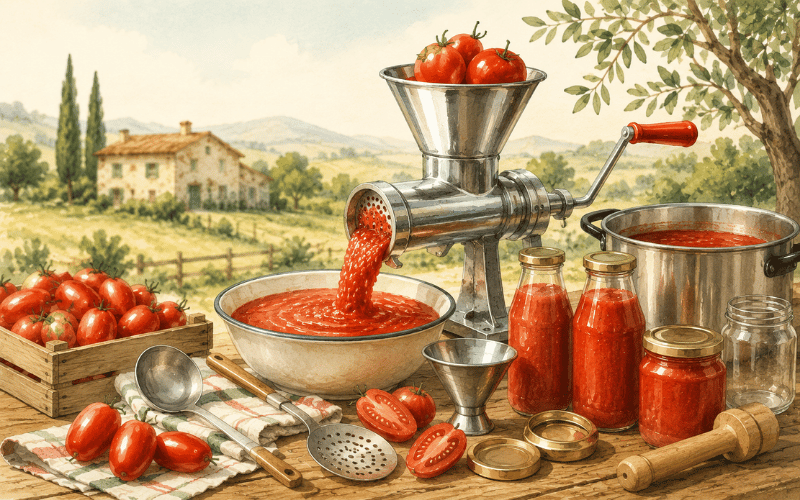
🍅 How to Make Homemade Tomato Passata: A Complete Guide with All Necessary Tools
Preparing homemade tomato passata is one of Italy's most beloved summer traditions. Every year, between July and September, many families organize to transform ripe, fragrant tomatoes into a genuine, flavorful preserve, ready to be used throughout the year.
To obtain quality passata, choosing good tomatoes is not enough. You also need method, attention, and above all, the right tools: tomato press, large pots, bottles, jars, lids, funnels, ladles, and specific accessories for working practically, quickly, and safely.
In this guide, we will see step-by-step how to make homemade tomato passata, which tools to use, and what precautions to follow to obtain a good, safe, and long-lasting preserve.
📌 Guide Index
- 📅 When to Make Tomato Passata
- 🍅 Which Tomatoes to Choose
- 🧰 Tools Needed to Make Passata
- 🚿 Preparing the Tomatoes
- 👨🍳 How to Prepare Passata Step-by-Step
- 🫙 How to Properly Bottle Passata
- 🔥 Sterilizing Bottles and Jars
- 📦 How to Store Passata
- ✅ Final Tips
📅 When to Make Tomato Passata
The best time to prepare homemade tomato passata is generally between July and September, when tomatoes reach their peak ripeness.
During this period, tomatoes are sweeter, more fragrant, and richer in pulp. Choosing the right moment means obtaining a passata with an intense color, a full-bodied consistency, and an authentic flavor.
The ideal tomato should be:
- well-ripened;
- uniformly red;
- firm but juicy;
- free from mold, bruises, or spoiled parts;
- rich in pulp and low in water.
🍅 Which Tomatoes to Choose for Good Passata
Not all tomatoes are suitable for making passata. The best varieties are those with plenty of pulp, few seeds, and a low water content.
Among the most commonly used varieties are:
- San Marzano, highly prized for its intense flavor and firm flesh;
- Roma, ideal for preserves and sauces;
- Perino, practical to work with and very productive;
- Fiaschetto, fragrant and with a traditional taste;
- industrial tomatoes, specifically selected for processing.
Before processing, it is important to remove all damaged tomatoes. Even a few rotten or overly soft fruits can compromise the flavor and final quality of the preserve.
🧰 Tools Needed to Make Tomato Passata
To prepare passata in an organized, fast, and safe manner, it is essential to have all the necessary equipment available before starting. Good organization helps avoid interruptions during processing and achieve a better result.
⚙️ Tomato Press
The tomato press is the main tool for separating tomato pulp from skins and seeds. It can be manual or electric.
The manual model is suitable for small quantities and occasional family use. The electric tomato press, on the other hand, is recommended when processing larger quantities of tomatoes and wanting to save time and effort.
A good tomato press must be stable, durable, easy to clean, and equipped with compatible accessories such as a filter, auger, hopper, plunger, splash guard, and chute.
🍲 Large Pots
Pots are essential for softening tomatoes before pressing and for the final sterilization of bottles and jars.
It is preferable to use large, robust, and easy-to-clean pots, suitable for holding large quantities of tomatoes or preserves.
🥄 Ladles, Skimmers, and Kitchen Utensils
Ladles, long spoons, skimmers, and spatulas are used to stir tomatoes during cooking, transfer the passata, and work more practically.
Stainless steel utensils are particularly suitable because they are durable, hygienic, and easy to wash.
🫙 Glass Bottles and Jars
To properly store passata, it is necessary to use clean, intact, and food-grade glass containers.
Bottles are very practical for liquid passata, while jars are useful for smaller quantities or denser preserves.
🔒 New Lids and Caps
Lids and caps must always be in good condition. It is advisable to use new lids for each preparation, because an imperfect seal can compromise the vacuum and the preservation of the passata.
funnel Funnels for Preserves
The funnel allows you to fill bottles and jars without making a mess and without wasting product. It is one of the simplest but most useful accessories during bottling.
🧩 Spare Parts and Accessories for Tomato Press
During tomato passata season, it is useful to always have some essential spare parts available:
- filter or filter cone;
- auger;
- spring;
- plunger;
- hopper;
- chute;
- splash guard;
- gaskets.
A worn accessory can slow down processing, reduce yield, and make it more difficult to obtain a homogeneous passata.
🚿 Preparing the Tomatoes
Before starting the processing, the tomatoes must be checked and thoroughly washed.
The correct preparation involves these steps:
- remove rotten, bruised, or overly soft tomatoes;
- wash the tomatoes with plenty of running water;
- remove stems and spoiled parts;
- cut larger tomatoes in half or into pieces;
- let them drain before cooking.
Careful selection improves the final taste of the passata and helps to obtain a cleaner, more uniform, and pleasant product.
👨🍳 How to Prepare Passata Step-by-Step
After washing and selecting the tomatoes, you can proceed with the actual preparation.
1. First Cooking of Tomatoes
The tomatoes are placed in a large pot and cooked for a few minutes, until they begin to soften. This phase facilitates their passage through the tomato press and allows for a better yield.
2. Passing Through the Tomato Press
Once softened, the tomatoes are fed into the tomato press. The machine separates the pulp from the skins and seeds, collecting the passata in a clean container.
3. Second Pass for Skins
To increase yield, skins and residues can be passed through the tomato press a second time. This step allows for the recovery of additional pulp and reduces waste.
4. Adjusting Consistency
If the passata is too liquid, it can be left to reduce slightly on the stove. If a more fluid preserve is desired, it can be kept more natural without long cooking.
5. Filling Containers
The still-hot passata is poured into clean bottles or jars, using a funnel for preserves.
🫙 How to Properly Bottle Passata
Bottling is a very important phase. Containers must be clean, intact, and suitable for food preservation.
When filling, it is advisable to leave a small space between the passata and the rim of the container. This helps with the correct formation of the vacuum during sterilization.
After filling, bottles and jars must be sealed with new caps or lids, screwed on tightly but without excessive force.
To work more neatly, it is useful to prepare everything beforehand:
- washed bottles or jars;
- new caps;
- funnel for preserves;
- ladle;
- clean cloths;
- stable work surface.
🔥 Sterilization of Bottles and Jars
Sterilization is the fundamental step for preserving passata over time. It serves to create a vacuum and protect the product during storage.
The closed bottles and jars are placed in a large pot, separated from each other with clean dishtowels to prevent bumping during boiling.
They are then completely covered with water and brought to a boil. The boiling time may vary depending on the size of the containers.
After sterilization, it is important to allow the containers to cool slowly in the pot or on a protected surface, avoiding sudden temperature changes.
✅ How to Check the Vacuum Seal
Once cooled, the jars should have the classic lowered center cap. If pressing on the lid produces a "click-clack" sound, the vacuum may not have been created correctly.
In case of doubt, it is best not to store the product for long and consume it within a short time.
📦 How to Store Homemade Tomato Passata
Once sterilization is complete, the passata should be stored in a cool, dry place away from direct sunlight.
Before placing the bottles in the pantry, it is useful to apply a label with the production date. This makes it easier to keep track of the order of consumption throughout the year.
Before opening, always check that:
- the cap is not bulging;
- the vacuum seal is intact;
- there are no leaks;
- the color of the passata is normal;
- there are no anomalous odors after opening.
After opening, the passata should be stored in the refrigerator and consumed within a few days.
✅ Final Tips for Perfect Passata
Preparing homemade tomato passata requires time, organization, and attention, but with the right tools, it becomes a much simpler and more satisfying activity.
The secret is to start with quality tomatoes, work with clean and reliable utensils, use suitable containers, and never neglect the sterilization phase.
To achieve a better result, it is advisable to prepare all the necessary items in advance:
- manual or electric tomato press;
- large pots;
- bottles and jars;
- new caps and lids;
- funnels for preserves;
- ladles and utensils;
- spare parts for the tomato press;
- clean cloths and food containers.
With good organization, preparing passata becomes not only a way to preserve the taste of summer but also a moment of tradition, family, and quality.
🍅 With the right tools, every step becomes easier: from choosing the tomato to final preservation.