
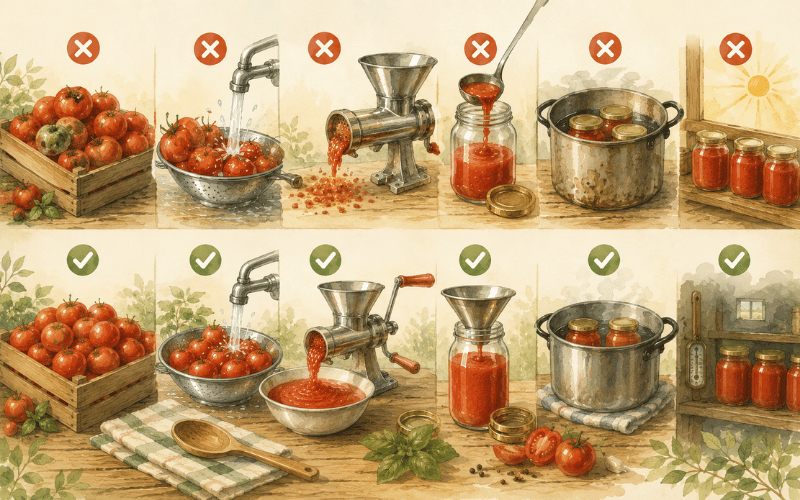
🍅 The 15 Most Common Mistakes When Making Tomato Passata and How to Avoid Them
Making homemade tomato passata is a wonderful tradition, but it requires attention at every stage. Even those who have been making it for years can make small mistakes that risk compromising the flavor, consistency, yield, and especially the proper preservation of the final product.
Good, fragrant, and safe passata comes from carefully selecting tomatoes, using the right tools, organized processing, and careful sterilization.
In this guide, we'll look at the 15 most common mistakes in preparing tomato passata and how to avoid them with practical, simple, and useful tips.
📌 Guide Index
- 🍅 1. Choosing unsuitable tomatoes
- 🚿 2. Washing tomatoes poorly
- ❌ 3. Not removing damaged tomatoes
- 🔪 4. Cutting tomatoes the wrong way
- ⚙️ 5. Using an unsuitable tomato press
- 🧩 6. Using worn-out parts
- 🫙 7. Reusing old caps
- 🧼 8. Not sterilizing bottles and jars properly
- 🌡️ 9. Filling containers with passata that is too cold
- 📏 10. Overfilling bottles and jars
- 🔥 11. Sterilizing for too short a time
- ❄️ 12. Cooling jars too quickly
- 📦 13. Storing passata in the wrong place
- 👀 14. Not checking the vacuum seal
- ⏳ 15. Consuming passata without checking it
- ✅ Conclusion
🍅 1. Choosing unsuitable tomatoes
The first mistake is thinking that any tomato is good enough for making passata. In reality, the quality of the final result depends heavily on the variety and ripeness.
The best tomatoes for passata are fleshy, with few seeds and little water. They should be ripe, red, fragrant, and healthy. Tomatoes that are too watery produce a thin, less substantial, and less flavorful passata.
The most suitable varieties are generally San Marzano, Roma, Perino, and canning tomatoes. Choosing quality tomatoes means getting a sweeter, thicker, and tastier passata.
How to avoid it: choose only ripe, firm, intact tomatoes suitable for processing.
🚿 2. Washing tomatoes poorly
A superficial wash can leave soil, dust, or impurities on the tomatoes. This is a mistake not to be underestimated, as initial cleaning directly affects the quality of the preserve.
Tomatoes should be thoroughly washed with plenty of running water, preferably several times, especially if they come directly from the garden or newly picked crates.
How to avoid it: wash tomatoes carefully, drain them well, and check them one by one before cutting or cooking.
❌ 3. Not removing damaged tomatoes
Another common mistake is leaving bruised, rotten, or blackened tomatoes in the processing. Even a few damaged tomatoes can alter the flavor of the passata and compromise the quality of the entire preparation.
Before starting, it's important to check each tomato and remove those that are too soft, fermented, moldy, or have an abnormal odor.
How to avoid it: select carefully before washing and discard any tomatoes that are not perfectly healthy without hesitation.
🔪 4. Cutting tomatoes the wrong way
Cutting tomatoes haphazardly or not removing tough and damaged parts can make processing less effective. Very large tomatoes should be cut in half or into pieces to facilitate initial cooking and passage through the tomato press.
The stem and hard parts must be removed, as they can negatively affect the consistency of the passata.
How to avoid it: cut larger tomatoes, remove bad parts, and prepare the product uniformly before cooking.
⚙️ 5. Using an unsuitable tomato press
The tomato press is one of the most important tools for making good passata. Using a model that is too small, unstable, or inefficient can slow down the work, increase effort, and reduce yield.
For small quantities, a manual tomato press may suffice, while for larger batches, an electric model is recommended for speed and practicality.
A quality tomato press effectively separates skins and seeds from the pulp, ensuring a smoother and more homogeneous passata.
How to avoid it: choose the tomato press based on the quantity of tomatoes to be processed and ensure it is stable, robust, and easy to clean.
🧩 6. Using worn-out parts
Filter, auger, spring, pestle, hopper, chute, and splash guard are fundamental components of a tomato press. If any of these elements are worn, deformed, or incompatible, processing can become slower and less precise.
A worn filter can let seeds and skins pass through. A damaged auger can push the tomato poorly. A broken spring can compromise the machine's proper functioning.
How to avoid it: always check the condition of spare parts before canning season and replace any damaged or inefficient accessories.
🫙 7. Reusing old caps
Reusing old caps is one of the riskiest mistakes. Even if they seem to be in good condition, caps may have lost their ability to seal properly.
A cap that does not seal well prevents a vacuum from forming and can compromise the preservation of the passata.
How to avoid it: always use new caps, suitable for the size of the jar or bottle, and check that they are not deformed or damaged.
🧼 8. Not sterilizing bottles and jars properly
Bottles and jars must be perfectly clean before use. Inadequate sterilization can compromise the safety of the preserve.
The glass must be intact, without cracks or chips. Even seemingly clean containers must be washed and treated carefully before filling.
How to avoid it: thoroughly wash bottles and jars, check that they are intact, and prepare them correctly before pouring the passata.
🌡️ 9. Filling containers with passata that is too cold
Pouring the passata when it's already too cold can make the preservation process less effective. Passata is usually bottled while still hot, following an organized and continuous process.
Leaving too much time between preparation and filling can also encourage undesirable contamination.
How to avoid it: organize your work well and fill the containers while the passata is still hot, using a clean funnel and ladle.
📏 10. Overfilling bottles and jars
Filling containers to the brim is a very common mistake. During sterilization, the passata can expand and create internal pressure. If the right amount of headspace is not left, the seal may be less effective.
It is important to leave a small gap between the passata and the rim of the container.
How to avoid it: never completely fill bottles and jars. Always leave adequate space to ensure a proper seal.
🔥 11. Sterilizing for too short a time
Sterilizing for too short a time may not be sufficient to create a safe preserve. The necessary time depends on the size of the containers and the amount of product.
Boiling must be carried out carefully, completely immersing bottles and jars in water and separating them with cloths to prevent them from knocking against each other.
How to avoid it: use large pots, completely cover the containers with water, and respect adequate boiling times.
❄️ 12. Cooling jars too quickly
After sterilization, bottles and jars should not be subjected to sudden temperature changes. Cooling them too quickly can cause glass breakage or compromise the seal.
It is preferable to let the containers cool slowly and naturally, without abruptly moving them.
How to avoid it: let the containers cool calmly, possibly in the same pot or on a protected surface.
📦 13. Storing passata in the wrong place
Even well-prepared passata can spoil if stored incorrectly. Direct light, heat, and humidity are enemies of homemade preserves.
Passata should be stored in a cool, dry place away from direct sunlight. An organized pantry also allows for easy monitoring of the bottles' condition over time.
How to avoid it: store the passata in a cool, clean, dry place away from light.
👀 14. Not checking the vacuum seal
The vacuum seal is fundamental for the proper preservation of passata. After cooling, it is necessary to check that the caps are well depressed and that they do not make the classic “click clack” sound when pressed in the center.
If the lid moves or makes a sound, the vacuum may not have been successful.
How to avoid it: always check every bottle and jar before storing them in the pantry.
⏳ 15. Consuming passata without checking it
Before using a stored bottle of passata, it is always important to check its condition. A swollen cap, a leak, an abnormal odor, or an altered color are signs not to be ignored.
Safety always comes before consumption. When in doubt, it is best not to use the product.
How to avoid it: always check the cap, odor, color, and consistency before using the passata.
✅ Conclusion
Making homemade tomato passata is a precious tradition, but it requires attention, organization, and suitable tools. Most mistakes can be avoided by preparing the work well, choosing quality tomatoes, and using appropriate equipment.
An efficient tomato press, good condition spare parts, intact bottles, new caps, funnels, large pots, and clean utensils are essential elements for working better and obtaining a better, safer, and longer-lasting preserve.
🍅 With the right precautions, making passata becomes simpler, safer, and much more satisfying.